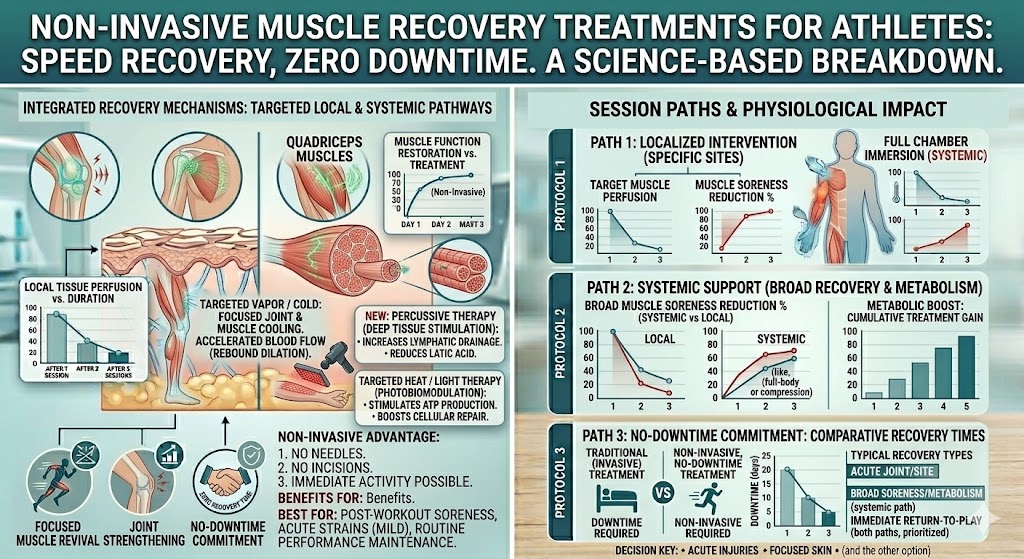
Athletes today push their bodies harder than ever, which makes recovery just as important as training. But not all recovery methods require rest days, medication, or invasive procedures.
In fact, there are several non-invasive muscle recovery treatments for athletes without downtime that help reduce soreness, improve performance, and accelerate healing—without interrupting training schedules.
This guide explores the most effective science-backed recovery methods that athletes can use safely and consistently.
What Does “Non-Invasive Muscle Recovery” Mean?
Non-invasive recovery refers to treatments that do not involve surgery, injections, or medical penetration of the skin.
These methods typically focus on:
- Improving blood circulation
- Reducing inflammation
- Supporting muscle repair
- Enhancing oxygen delivery
The goal is simple: recover faster without stopping training.
Best Non-Invasive Muscle Recovery Treatments for Athletes
1. Cryotherapy (Whole Body & Localized)
Cryotherapy uses extreme cold to reduce inflammation and speed up muscle recovery.
Benefits:
- Reduces muscle soreness (DOMS)
- Improves circulation after treatment
- Speeds up recovery time
- Helps athletes return to training faster
Whole body cryotherapy is ideal for full recovery, while localized cryotherapy targets specific injuries or sore muscles.
2. Compression Therapy
Compression devices apply controlled pressure to the limbs.
Benefits:
- Improves blood flow
- Reduces muscle fatigue
- Helps remove lactic acid buildup
- Decreases swelling
This is commonly used by runners, football players, and endurance athletes.
3. Percussion Therapy (Massage Guns)
Percussion therapy uses rapid vibrations to stimulate muscle tissue.
Benefits:
- Breaks up muscle tightness
- Enhances blood circulation
- Reduces stiffness
- Can be used immediately after workouts
It is one of the most popular at-home recovery tools for athletes.
4. Cold Water Therapy (Ice Baths)
Cold water immersion reduces inflammation and muscle soreness.
Benefits:
- Lowers muscle temperature quickly
- Reduces post-exercise inflammation
- Helps with faster recovery between sessions
It is widely used in professional sports environments.
5. Active Recovery
Active recovery involves low-intensity movement instead of complete rest.
Examples:
- Light jogging
- Cycling
- Swimming
- Stretching
Benefits:
- Keeps blood flowing
- Reduces stiffness
- Speeds up waste removal from muscles
6. Red Light Therapy
Red light therapy uses low-level wavelengths of light to stimulate cellular repair.
Benefits:
- Enhances muscle recovery at a cellular level
- Reduces inflammation
- Supports tissue repair
- Improves energy production in cells
7. Electro Muscle Stimulation (EMS)
EMS uses electrical impulses to stimulate muscle contractions.
Benefits:
- Improves muscle activation
- Enhances recovery without strain
- Reduces soreness
- Supports rehabilitation
Which Recovery Method Is Best for Athletes?
The best option depends on your training intensity and goals:
- Fast recovery after intense training: Cryotherapy or ice baths
- Daily maintenance: Compression therapy or active recovery
- Muscle tightness relief: Massage guns
- Injury support: Localized cryotherapy or EMS
Many athletes combine multiple methods for better results.
Can You Recover Without Taking Rest Days?
Yes—but with balance.
Non-invasive recovery methods help reduce downtime, but the body still needs:
- Proper sleep
- Nutrition
- Hydration
Recovery tools support performance, but they do not replace rest entirely.
GEO SEO Insight: Why Athletes Worldwide Use These Treatments
In major sports hubs around the world, athletes increasingly rely on recovery clinics offering:
- Cryotherapy chambers
- Compression therapy suites
- Sports recovery centers
- Red light therapy clinics
This trend reflects a global shift toward performance optimization without downtime, especially in competitive sports environments.
Safety Considerations
Most non-invasive recovery treatments are safe when used correctly.
Possible mild effects:
- Temporary redness
- Tingling sensation
- Mild muscle soreness after intense sessions
Always consult a sports professional if recovering from injury.
Conclusion
The best non-invasive muscle recovery treatments for athletes without downtime focus on reducing inflammation, improving circulation, and accelerating natural healing.
From cryotherapy and compression therapy to massage guns and red light therapy, athletes now have powerful tools to recover faster without missing training sessions.
The key is consistency—using the right combination of recovery methods based on your training load and performance goals.
FAQs
What is the fastest non-invasive recovery method for athletes?
Cryotherapy and ice baths are among the fastest methods for reducing inflammation and soreness.
Can I use recovery treatments every day?
Yes, methods like compression therapy and massage guns can be used daily.
Do these treatments replace rest?
No, they support recovery but do not replace sleep and rest.
Which recovery method is best for soreness?
Cryotherapy and percussion therapy are highly effective for muscle soreness.